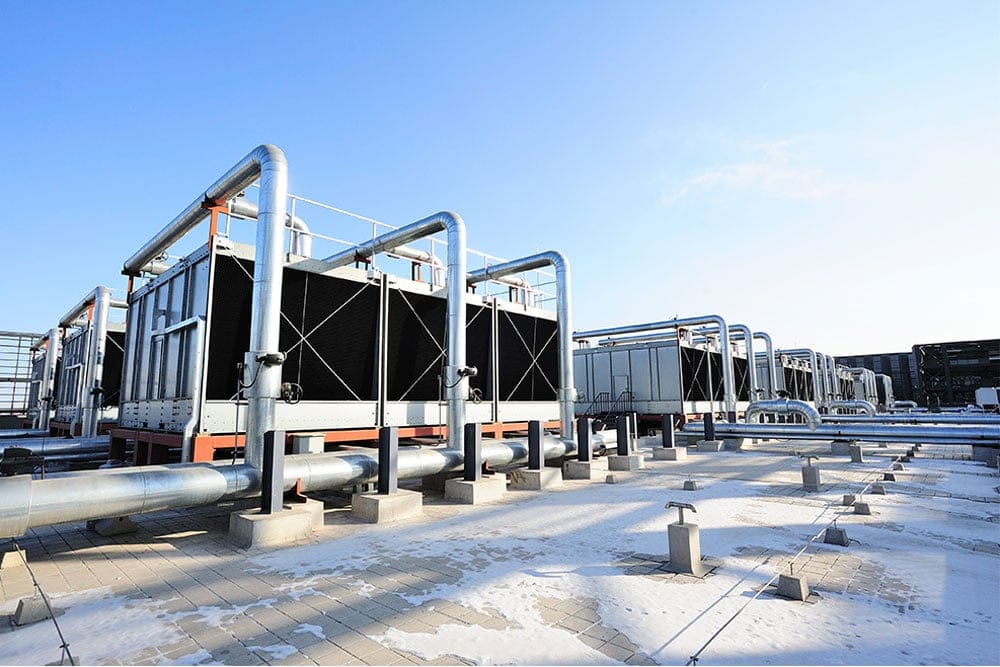
A considerable number of Northeast Ohio’s commercial buildings were constructed before modern HVAC standards existed. Many of the office buildings, warehouses, retail centers, and industrial facilities in Cleveland, Akron, and Canton are running mechanical systems that are decades old, in some cases approaching or exceeding their expected service life.
It’s not automatically a problem. Older HVAC systems can run reliably when they’re properly maintained. The issue is that aging equipment has less margin for error. A component that would be a minor inefficiency in a newer system becomes a failure point in an older one, especially with the added stress that Northeast Ohio’s climate puts on mechanical systems year-round.
Regular inspections are how building owners and facilities teams stay ahead of that reality.
Key Takeaways:
- Much of Northeast Ohio’s commercial building stock runs HVAC equipment that’s decades old, and the region’s harsh winters, humid summers, and wide seasonal swings accelerate wear on aging mechanical systems.
- Older buildings commonly face three categories of problems: equipment that has outlived its 15- to 25-year design life, outdated airflow design that no longer matches occupancy patterns, and worn mechanical and electrical components that quietly degrade efficiency.
- Skipping inspections in aging buildings leads to compounding inefficiencies, unexpected breakdowns during peak demand periods, and indoor air quality issues from dirty coils, failed filtration, or cracked heat exchangers.
- A complete commercial HVAC inspection covers mechanical components, heat exchangers, electrical systems, refrigerant levels, airflow measurement, filter condition, controls calibration, ductwork integrity, and overall system performance against design specifications.
- Buildings with systems older than 15 years should schedule inspections twice per year (spring and fall) and quarterly for properties with recurring service calls, complex multi-zone configurations, or mission-critical operations.
How the Climate Affects Aging Commercial HVAC Systems
Northeast Ohio experiences the full range of seasons. Winters regularly fall below zero, putting sustained demand on heating systems for months at a time. Summers bring heat and humidity off Lake Erie that force cooling systems to work harder than the temperature alone would suggest. And the seasonal swing between those two extremes imposes constant mechanical stress on components that cycle between maximum heating and maximum cooling.
For a building with newer equipment and modern controls, the fluctuation is manageable. For a building running 20-year-old rooftop units or a boiler system that predates current efficiency standards, every season adds wear that doesn’t always surface until something fails.
Cleveland, Akron, and Canton have no shortage of commercial properties in exactly that position, including industrial facilities that haven’t had a complete system update in years. Office buildings where the HVAC was installed during a build-out that’s now two decades old. Multi-tenant retail properties where the original mechanical design was never meant to handle today’s occupancy loads or equipment densities.
Common HVAC Problems in Older Commercial Buildings
Aging commercial buildings tend to exhibit the same HVAC problems. They don’t always present as dramatic failures. More often, they lead to rising energy costs, inconsistent temperatures across zones, or equipment that keeps running but never quite performs the way it should.
Outdated Equipment Running Past Its Design Life
Most commercial HVAC equipment has a design life of 15 to 25 years, depending on the system type and how well it’s been maintained. A rooftop unit that’s been running for 20 years in the Northeast Ohio climate has endured countless heating and cooling cycles. Even if it’s still operational, its efficiency has likely dropped well below its original rating, and the components inside are operating closer to the end of their useful lives than at the beginning.
Running equipment past its design life isn’t always the wrong call. But it requires more frequent inspection, not less, because the failure modes become harder to predict.
Poor Original Airflow Design
Buildings that were designed or renovated before modern HVAC engineering standards were common usually have ductwork that doesn’t match today’s occupancy patterns or equipment loads. Zones that were intended for one use have been converted to another. Areas that were open floor plans now have interior walls that interrupt airflow paths. The result is hot and cold spots, pressure imbalances, and systems that run longer trying to compensate for distribution problems that the equipment alone can’t solve.
Worn Mechanical and Electrical Components
Belts, bearings, contactors, capacitors, heat exchangers, and wiring all degrade over time. In older buildings, these components may never have been replaced since the original installation. They still function, but they operate with reduced efficiency and a higher risk of failure. A heat exchanger with hairline cracks poses both an efficiency and an indoor air quality problem. Worn electrical contacts on a contactor can cause intermittent failures that are difficult to diagnose without a direct inspection.
The Risks of Skipping Inspections in Older Buildings
Older HVAC systems that aren’t regularly inspected tend to fail in predictable ways at unpredictable times. The three most common consequences are noted below:
- Efficiency losses that compound over time. A system operating at 70 percent of its rated efficiency is costing the building significantly more to operate than one running at 90 percent. That gap widens as components continue to degrade between inspections.
- Unexpected breakdowns during peak demand periods. Older equipment is most likely to fail when it’s working hardest: during a Northeast Ohio cold snap or a July heatwave. Those are the moments when emergency service costs are highest, and replacement parts may have lead times.
- Indoor air quality problems. Dirty coils, failed filtration, cracked heat exchangers, and drainage issues in aging systems can affect air quality in ways that aren’t immediately visible but have real consequences for building occupants.
What an Enervise Commercial HVAC Inspection Includes
A thorough HVAC inspection checklist for a commercial building in Northeast Ohio covers more ground than a basic filter swap and visual check. For older buildings especially, a complete inspection should include these elements:
- Mechanical Component Review: belts, bearings, motors, and fan assemblies for wear and operational condition
- Heat Exchanger Inspection: checking for cracks or deterioration that affect both efficiency and air quality
- Electrical Systems: contactors, capacitors, wiring connections, and control boards for signs of wear or failure risk
- Refrigerant Levels and Line Integrity: checking for leaks in aging refrigerant lines and confirming charge levels
- Airflow Measurement: testing delivery at registers and returns to identify distribution imbalances
- Filter Condition and Replacement: confirming filter types match system specifications for older equipment
- Thermostat and Controls Calibration: verifying that controls are reading accurately and responding correctly
- Ductwork Integrity: checking for leaks, damaged insulation, and blocked or disconnected sections
- Drain Pan and Condensate Line Condition: clearing any blockages and checking for corrosion in older pans
- Overall System Performance Assessment: comparing current output against design specifications where documentation is available
For buildings with systems that are 15 or older, the inspection should also include a condition assessment to give the facilities team a realistic picture of remaining useful life and what capital investments to plan for.
| If your commercial building in Cleveland, Akron, or Canton is running aging HVAC equipment, a professional inspection is the starting point for knowing where you stand. Contact Enervise to schedule a commercial HVAC inspection. |
How Routine Inspections Reduce Long-Term Costs
The case for regular commercial HVAC maintenance in older buildings isn’t just about avoiding breakdowns. It’s about controlling costs across a longer timeline.
A building that has inspections twice a year and addresses findings proactively tends to spend less on HVAC over a five-year period than a building that defers maintenance and handles problems as they arise. Emergency service calls cost more than scheduled visits. Compressor replacements triggered by electrical failures that an inspection would have caught are more expensive than replacing a worn contactor. Replacing a rooftop unit years earlier than necessary because it was neglected costs more than the maintenance program that could have extended its life.
HVAC system efficiency is also directly tied to energy costs. Older equipment running in poor condition uses more energy to deliver the same output. Regular inspections that keep components clean, properly charged, and correctly calibrated narrow the gap between actual and rated efficiency.
How Often Should Older Buildings Schedule Northeast Ohio Commercial HVAC Inspections?
For commercial buildings in Northeast Ohio with systems under 10 years old and no recurring issues, annual inspections plus seasonal filter maintenance are a reasonable baseline.
For buildings with aging systems, the standard recommendation is twice per year: once in spring before the cooling season and once in fall before the heating season. That timing puts a technician on-site when each major mode of operation is about to be tested hardest.
Buildings that meet any of the following criteria should consider quarterly inspections:
- HVAC systems 15 years or older
- History of recurring service calls or unexplained efficiency losses
- Complex multi-zone configurations in buildings that have been renovated or reconfigured since original construction
- High-occupancy or mission-critical spaces where HVAC failure has serious operational consequences
For multi-property portfolios in the Cleveland, Akron, or Canton area, a service agreement that includes scheduled inspections at all sites is typically more cost-effective than individual visits and provides facilities teams with a consistent baseline for tracking system condition over time.
Frequently Asked Questions
What HVAC problems are most common in aging commercial buildings?
Older buildings typically have undersized or outdated equipment, corroded heat exchangers, failed duct insulation, worn belts and bearings, refrigerant leaks in aging lines, and control systems that can no longer communicate with modern building management platforms.
Why are HVAC inspections critical for older commercial properties in Northeast Ohio?
Northeast Ohio’s climate is hard on mechanical systems. Harsh winters, humid summers, and wide seasonal temperature swings accelerate component wear. Older buildings frequently have systems designed for different occupancy loads and energy standards than they’re operating under today.
What does a commercial HVAC inspection include?
A thorough commercial inspection covers mechanical components (belts, bearings, motors, heat exchangers), electrical systems (contactors, capacitors, wiring), refrigerant levels, airflow measurement, filter condition, control system calibration, ductwork integrity, and an overall efficiency assessment.
How often should older commercial buildings schedule HVAC inspections?
Twice per year is the standard recommendation for buildings with aging systems: once in spring before the cooling season, and once in fall, before the heating season. Buildings with systems over 15 years old, complex zoning, or a history of frequent service calls benefit from quarterly check-ins.
Know Where Your Building Stands Before Something Fails
Older commercial buildings in Northeast Ohio aren’t going away, and neither are the maintenance demands that come with aging HVAC systems. The difference between a building that manages that reality well and one that doesn’t is usually whether inspections are conducted on a consistent schedule or only after something breaks.
Enervise Akron works with commercial properties across Cleveland, Akron, and Canton to keep aging HVAC systems running reliably, efficiently, and within the capital budget that building owners and facilities teams are working with. Schedule a commercial HVAC inspection with Enervise and get a clear picture of your system’s current condition.